
Poor watchkeeping blamed for fatal North Sea Verity–Polesie collision
13 March 2026
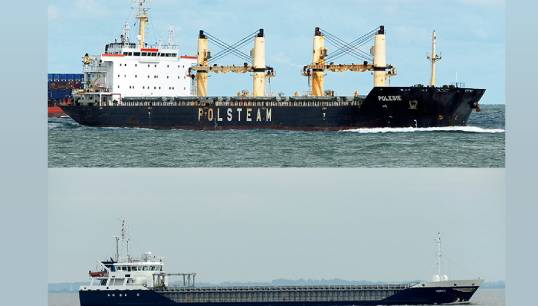
Inadequate watchkeeping and ineffective collision avoidance manoeuvres led to a fatal North Sea collision between the bulk carrier Polesie and the general cargo ship Verity, a Marine Accident Investigation Branch (MAIB) report has found.
Five of the seven Verity crew died after the Isle of Man-flagged general cargo carrier sank rapidly following the collision in the German Bight on 24 October 2023.
Before the collision, the Bahamas-flagged bulk carrier Polesie was heading westbound from Hamburg to Spain in the traffic separation scheme and Verity was heading northbound from Bremen to Immingham in the UK 'such that a risk of collision existed', according to the report.
MAIB investigators concluded that both vessels accepted unsafe passing distances and failed to take early, positive, and clearly identifiable action as required under the amended International Regulations for Preventing Collisions at Sea, 1972 (also referred to as the COLREGs). The MAIB added that earlier use of VHF radio could also have helped resolve the situation.
The report criticised a late and ineffective intervention by German Bight Vessel Traffic Services (VTS), noting that the guidance provided was unlikely to influence events at that stage. It also noted that 'restrictions on interviewing key witnesses limited the investigation's ability to explore the rationale behind the actions taken by Polesie's watchkeeper and the decisions and actions taken by the staff at German Bight vessel traffic services'.
Verity sustained catastrophic structural damage in the collision and sank quickly, leaving the crew with no opportunity to don lifejackets or immersion suits before abandoning the vessel. The investigation was conducted by the MAIB on behalf of the Isle of Man administration in accordance with the Memorandum of Understanding between the MAIB and the Red Ensign Group Category 1 registries of Isle of Man, Cayman Islands, Bermuda and Gibraltar. The right under German law of some witnesses to remain silent was respected.
Chief inspector of marine accidents Andrew Moll said the tragedy was 'wholly avoidable', noting that neither vessel followed collision prevention regulations or maintained safe passing distances. He stressed the need for early, clear action from give-way vessels, timely and appropriate VTS intervention, and correct use of VHF to clarify intentions.
Key Recommendations
The MAIB underscored several safety lessons for the wider shipping community:
- shipping companies should remind crews to comply with COLREGs for keeping a safe navigational watch
- Germany's Directorate General for Waterways and Shipping should review VHF channel use and strengthen guidance on IALA communication protocols
- the Isle of Man Ship Registry should propose expanded voyage data recorder carriage requirements to the International Maritime Organization
The International Organization for Marine Aids to Navigation has also updated its guidelines on the use of duplex radio channels by vessel traffic services.
Read the full report here.
Tags
More articles
Spirit of Discovery propulsion failure highlights 'clear lessons' on safety and decision making
The MAIB has identified 'clear lessons' on vessel safety, crew decision making and onboard medical responses after its investigation found that violent ship motion in heavy weather led to a propulsion failure on the UK-flagged Saga Cruises vessel Spirit of Discovery.
Advice to UK shipowners operating in the Persian Gulf following 'Warlike' designation
The UK Warlike Operations Area Committee (WOAC) has formally designated the Persian Gulf (PG), Straits of Hormuz (SoH) and Gulf of Oman (GOO) as a warlike area.
UK designates Strait of Hormuz a warlike area
The UK Warlike Operations Area Committee (WOAC) has formally designated the Persian Gulf (PG), Straits of Hormuz (SoH) and Gulf of Oman (GOO) as a warlike area.