
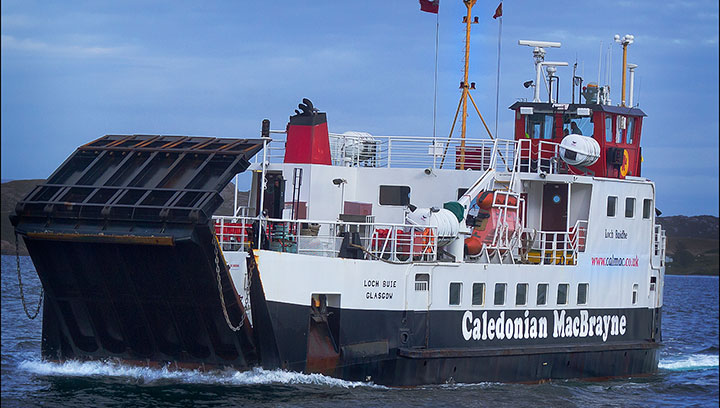
Rob Coston examines a new report which attempts to distil what island communities truly need from the ferry services that support their lives, and provides concrete methods for winning back their trust
The release of the Glasgow University report A stakeholder model of public ferry service provision comes at a pivotal moment.
In May 2025 the decision was taken to renew CalMac’s contract to run the Clyde and Hebrides Ferry Service for another 10 years. That makes the question not who runs the ferries, but how they are run.
In November 2025, Nautilus head of industrial Micky Smyth visited Glasgow University for the report’s release, alongside colleagues from the RMT union and representatives from communities, ferry groups and industry.
‘The authors from Glasgow University’s Adam Smith Business School did an excellent job in producing the report and presenting it on the day,’ Mr Smyth says.
‘Nautilus participated in the research, and we are very supportive of the report and the recommendations it makes.’
Perception problems
The report begins by assessing public views of the service. In the islands visited, residents of all ages and backgrounds repeatedly described the ferry as fundamental infrastructure underpinning almost every dimension of island life. One participant from Mull summed it up plainly: ‘Life revolves very much around the ferries’.
However, this means that when there are cancellations or unpredictable schedules, the consequences are far beyond inconvenience. Medical appointments are missed, shops may go days without fresh stock, small businesses lose revenue, people miss important life events which affects their emotional wellbeing, and workers lose pay.
Unsurprisingly, the most urgent and recurrent public theme was reliability. Participants voiced frustration with inconsistency: delays, cancellations, and unpredictability. For many, the decline has been gradual but perceptible over years, with trust in ferry provision eroded.
Yet the survey revealed that, paradoxically, people who travel most often by ferry were less dissatisfied than those with more sporadic usage. That suggests people who have built their life around ferry rhythms adapt their expectations accordingly. But the unreliability still resonates.
Many interviewees recognised that structural issues, like ageing vessels, failure to invest in new ships, and a mismatch between fleet and port infrastructure, underlie the problem. This helps explain why many see the unreliability as something worse than mere intermittent misfortune.
Another critical thread in the research is the growing sense that island communities are ‘over-consulted yet under-heard’, with cycles of public consultations but few real changes. The report’s authors emphasise that the split between the operator, the asset owner, and the government funder leaves residents unclear about who is responsible and who they can hold accountable when something goes wrong or they are unhappy with decisions about routes or scheduling. This further undermines trust.
Valued workers
Amid the frustrations, there was widespread recognition of the people who keep the ferries running. Front-line staff – crew, port workers, ticketing clerks – were routinely praised for being courteous, resilient and community-oriented. Many respondents differentiated between the failures of institutions and the integrity of workers.
On some islands, ferry-related work remains one of the last reliable, well-paid opportunities that allow native islanders to remain at home rather than leaving for the mainland. For many, the personal connection helps sustain trust.
In addition, the data collected for the report shows that while complaints about cancelled sailings and delays have some basis, the service is extremely safe, generally good and meets targets for reliability and punctuality in most cases, as well as – for example – exceeding the overall customer satisfaction rating set in the Clyde and Hebrides Ferry Services (CHFS) contract made with the Scottish government.
However, the authors note that ‘the public perception both on the islands and more generally in Scotland and beyond is that the service is very poor and unreliable when, notwithstanding the problems which have arisen from one particular procurement issue, this is far from the case. ... If islanders feel that there is doubt over whether they will be able to travel on the few occasions they wish to for important family events or for hospital appointments, that affects their wellbeing even at times when they are not planning to travel. The lack of confidence in the service causes real impacts regardless of what the material reality is.’
Towards a better model
The authors of the study propose two paths towards rectifying the breakdown of trust in recent years. This has come about, they say, during the period when public discourse on the service has focused on the delayed delivery of the two vessels built by Ferguson Marine and the ongoing impact of the delays in the project.
The options for improvement are:
- a full reintegration of CalMac and CMAL
- or a transparent, strategic framework that leaves no doubt over who is responsible for decision-making when services affect users
To improve the service, they also call for an overhaul of communication practices: when things go wrong, the crew that islanders already know and trust should have a genuine role in communications. This approach could involve specific training for those workers who are in regular contact with customers and associated rewards for increases in responsibility.
Our members are at the frontline and have always been the first point of contact with those who depend on these lifeline services, whether it be in the booking offices, terminals, or on the vessels. It is no surprise that respondents to the survey were so impressed by the staff’s hard work, integrity and professionalism
Who contributed to the report?
A stakeholder model of public ferry service provision was produced by Glasgow University’s Adam Smith Business School. The researchers were Professor Jeanette Findlay, Dr Dania Thomas and Paul Quigley
Working from late 2022 to mid-2025, the researchers took evidence from:
- 15 focus groups on Arran, Mull, Islay, Barra and Shetland, comprising around 70 participants
- 14 interviews with executives from CalMac, CMAL and Transport Scotland, Nautilus International and the RMT union
- nearly 600 survey responses
Finally, they propose a thorough review of methods of consultation, arguing that, in future, researchers need to focus on asking service users about only appropriate issues such as what facilities they would like to see onboard. Asking technical questions (e.g. around ship design), then having to discard the responses and failing to explain why, only ‘breeds frustration and distrust and makes communities feel over-consulted and underheard’, the authors say. Meanwhile, ferry workers in various roles are in a better position to answer such questions and should be consulted more.
Time for action
As new vessels come online – including one already in service as of January 2025, with a second expected in 2026 – there is a window to rebuild not only the fleet, but the relationships between islanders, crew, and institutions.
Now it is time for the companies and the Scottish government to act.
On 4 December 2025, Richard Leonard (L), MSP for Central Scotland, asked the Scottish government for its response the recommendations of the report. This response was returned on 18 December, with the Scottish government stating that the report addresses many of the same themes as its own recently published Islands Connectivity Plan and giving reasonably supportive comments – although these comments are largely noncommittal except in the case of communications.
Replying to Mr Leonard, the government stated: ‘Ministers have not taken any decisions at this stage on potential further reforms to the governance of Scotland’s ferry bodies. Work to consider all available options is ongoing, and no approach has been ruled out.’
The importance of consultation with stakeholders was also mentioned, with the government agreeing that ‘it is vital to hear from a wide range of voices’ and stating: ‘Ministers, Transport Scotland officials, CalMac and CMAL will continue to engage with island communities, businesses, staff, trades unions and wider stakeholders across the network on new policy, timetables and projects to fully understand the wider range of challenges and opportunities as we invest to sustain and enhance services.’
Regarding communications, the government pointed out that as part of the CHFS3 grant agreement (the latest contract for running the ferries), CalMac will be preparing a customer service and accessibility plan and a disruption management plan to consider these matters further.
Nautilus’s Micky Smyth said: ‘Our members are at the frontline and have always been the first point of contact with those who depend on these lifeline services, whether it be in the booking offices, terminals, or on the vessels. It is no surprise that respondents to the survey were so impressed by the staff’s hard work, integrity and professionalism, Nautilus will, of course, discuss CalMac’s communications plans with management as they develop, and address any concerns from our members as maritime professionals at sea and ashore delivering these lifeline services.’
Read the full Glasgow University report here.
Tags