On 10 May, Nautilus members at the Royal Fleet Auxiliary will begin taking action short of a strike. Rob Coston speaks to the Union's director of organising Martyn Gray about why the longstanding dispute has escalated again, what that means for the RFA, and what members can expect in the weeks ahead
ROB COSTON (RC): Why have our members decided to undertake industrial action again, and why now?
MARTYN GRAY (MG): Following the agreement reached in January 2025 between Nautilus and the Royal Fleet Auxiliary (RFA), several key milestones were established – what we considered to be concrete commitments that both sides made, but which seem to have been approached in terms of aspirations as opposed to definitive actions.
We spent a significant amount of time across 2025 discussing these areas with various representatives from the RFA and the Ministry of Defence (MoD): challenges from usual working patterns; challenges with disciplinaries and grievances; challenges with parental leave policies; challenges with policies in general; and routine bureaucratic difficulties that members were experiencing on almost a daily basis.
There is an awful lot of inertia when dealing with the government. It is slow to get moving, and it is slow to stop and change direction – but there's slow, and then there's glacial. We engaged initially to reset the collective bargaining arrangement, which took more than 12 months. Regarding pay, it took until December to get an offer tabled in terms of leave and cash for the pay period 2025-2026.
At present, members are increasingly frustrated at the glacial pace. While we have seen almost a reset of recent industrial relations, from members' perspectives we are now more than 12 months into discussions on pay, conditions, terms of service and working routines with very little to show for it.
The pay offer was rejected by a significant majority of members, who followed this with a ballot outcome where 95% were in favour of industrial action short of a strike, and 88% were in favour of taking full strike action. So the Union has been remarkably restrained in our approach with the government so far, and the escalation that was announced on Wednesday 6 May follows a lengthy period of consideration.
If you are one of our RFA members and you have questions or face undue pressure to go against the industrial action, please make contact with us so we can offer help, support and further guidance
RC: Can you share how our members are feeling about the situation?
MG: Frustrated. It's incredibly frustrating for them to watch history repeat itself. This dispute has really been going on for three years now, and while we've seen some progress along the way we've also seen commitments go undelivered.
Nautilus is doing everything we can to push harder and to demonstrate the strength of feeling to the RFA and MoD, and we have done everything we can to escalate at appropriate levels. But unfortunately, the inertia, the delay, and the lack of meaningful progress that we can demonstrate to members in these talks all mean that members are demanding that they take action. They have a live and valid mandate, and lawful industrial action will take place and will likely escalate should the situation not be resolved in the very near future.
RC: What are the RFA and MoD thinking as we enter this industrial dispute?
MG: I have no doubt that the RFA and MoD leadership that we're working with are very supportive of achieving a resolution that works for members and that works for them. Our meeting on 6 May with the second sea lord, alongside senior colleagues from the Royal Navy and MoD, showed a significant tonal shift and recognition of the historic challenges within the RFA. There is a willingness to listen, a recognition that issues run deep and an intention to move forward, but at a pace that avoids repeating past mistakes of overpromising and underdelivering.
However, resolving our demands requires Treasury decisions. It is extremely frustrating as a negotiator not to be able to talk to the people that write the cheque, because you are working through third parties that you must trust to accurately communicate your position onwards to the ultimate the decision makers. It's also not conducive for quick outcomes.
RC: How is this action going to proceed?
MG: First of all, it's important to state that the safety of vessels, the safety of lives, and the safety of the environment will be maintained throughout the action. Our members are all professional seafarers who understand their obligations.
The action is essentially a removal of goodwill. Our members won't come back early to help because an issue has arisen. They won't come back and work at a different grade or rank because the RFA needs somebody capable of delivering that other role. They won't stay onboard longer than they have to because the RFA is struggling to find a relief. The RFA relies on this everyday goodwill for its operations because of how few skilled people there are to work in key 'pinch' roles and responsibilities.
RC: Last time, our members got some of what they wanted and a commitment to further change. However, industrial action can be a long, tough process. What would you say to our members as they begin the action anew?
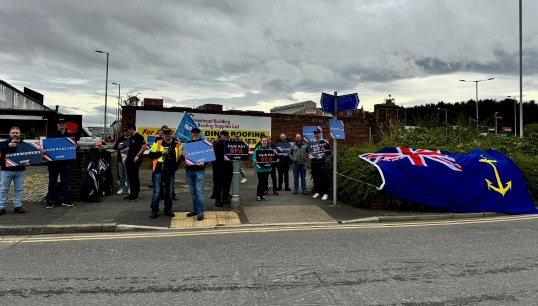
MG: Standing together matters, and being able to demonstrate on picket lines and to say no is what is going to make the difference here.
The RFA, Royal Navy and MoD leadership are all too aware of the vital importance of the work that the RFA does, but I'm certain that the country and the wider government don't appreciate just how critical the Royal Fleet Auxiliary is. This may now be the time where they have to learn a very difficult lesson in a time of significant geopolitical conflict.
For our members, it is essential that members read, understand and follow the guidance on industrial action short of a strike, which was emailed on 7 May. If you are one of our RFA members and you have questions or face undue pressure to go against the industrial action, please make contact with us so we can offer help, support and further guidance. We'll clarify the situation and work with you. Together, we can ensure the action is both impactful and effective, and we can more quickly reach a resolution you will be happy with.
Tags