
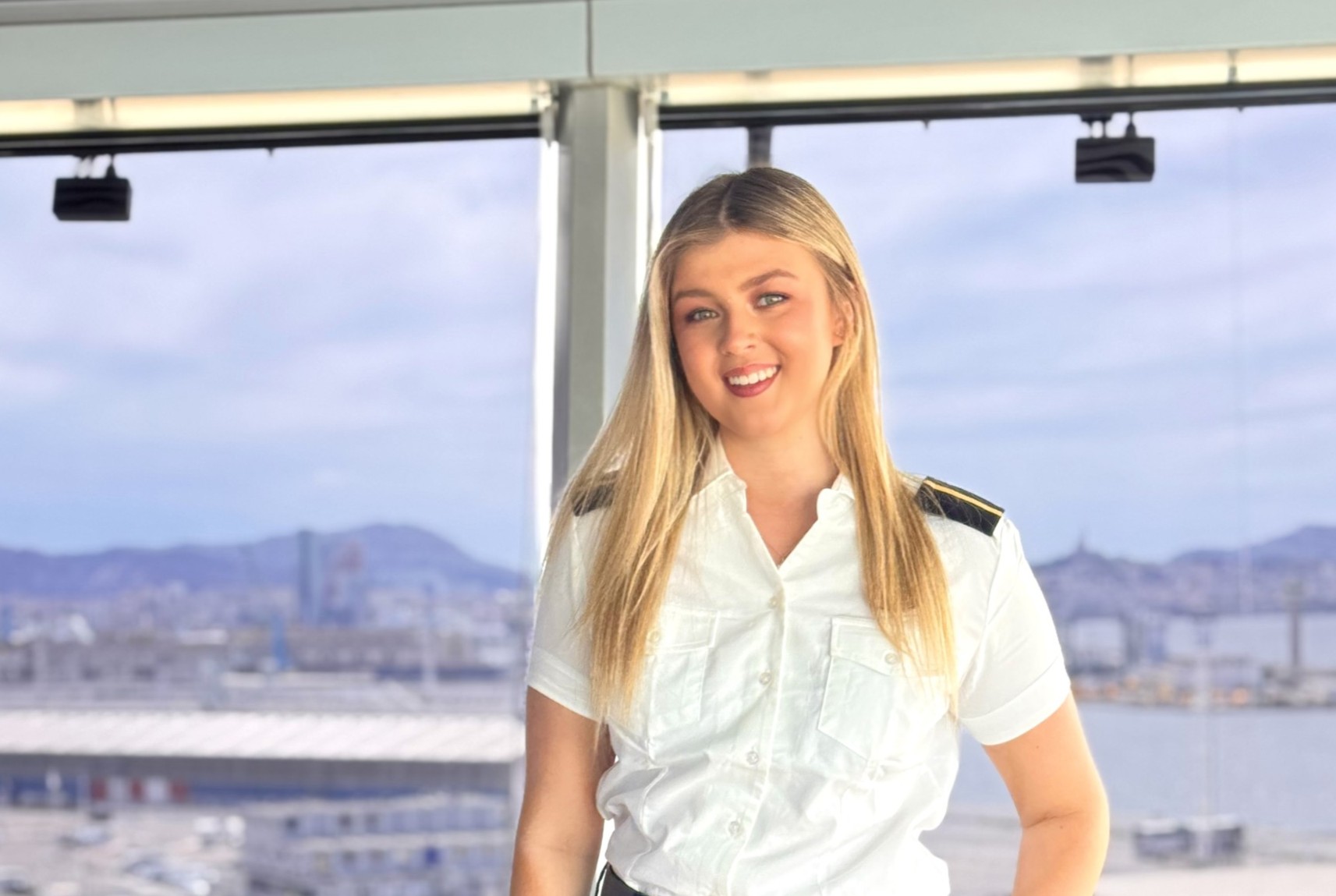
The maritime industry faces one of its defining challenges: achieving net zero by 2050. For Sophie Longhurst, a deck cadet with Princess Cruises currently serving aboard Enchanted Princess, sustainability is not an abstract corporate target, it is the daily reality of life at sea.
Speaking on the Off Course podcast, Ms Longhurst describes how environmental responsibility is woven into the fabric of her work on the bridge. ‘At the end of the day, it is my job – it’s my future.’
Princess Cruises' environmental strategy is formalised through its Planet Princess initiative, a programme of pledges covering single-use plastic reduction, improved recycling, and the broader goal of protecting ocean health, marine life and air quality for future generations.
Princess Cruises was an early adopter of shore-side power, or 'cold ironing', which allows ships to connect to the local electricity grid whilst in port, switching off their engines and reducing emissions.
On board, sophisticated waste treatment systems manage the considerable volumes of laundry, food waste and general refuse generated by what is, in effect, a floating hotel. As Ms Longhurst puts it, the challenge lies in making sustainability invisible to the guest experience. ‘It’s trying to make those adjustments that go blind to the eye, but overall have a big impact.’
Navigating sustainability
As a bridge officer in training, Sophie is learning about planning fuel changeovers, a critical operation as ships sail in and out of Emission Control Areas (ECAs). These are designated zones, typically close to coastlines, where regulations mandate the use of lower-sulphur fuels to reduce particulate emissions into the atmosphere.
'It is planned so carefully, we aim to go above what the law requires.'
Ms Longhurst is clear-eyed about what the path to net zero will require. 'Definitely looking at moving more from heavy fuel oil (HFO) to marine gas oil(MGO), because that is going to be better for the environment overall. And a lot of the newer class of cruise ships now use liquefied natural gas (LNG), which still emits carbon, but at a reduced rate.'
Sustainability at sea extends well beyond fuel. Ms Longhurst describes a heightened awareness on board of marine wildlife, particularly whales. 'As soon as anyone says whale, it's a complete stop, look, we're really, really cautious,' she says.
The ship adheres to local noise restrictions in sensitive coastal areas, a growing requirement as regulators move to protect migratory whale populations from the disruptive effects of underwater vibration.
Despite the positive steps being taken at an operational level, Ms Longhurst believes the formal training curriculum still has room to grow. 'Going through my cadetship, I'd love to learn more about sustainability,' she says.
She is optimistic, however, that the direction of travel is right and that as new officers join the industry with sustainability already close to their hearts, the culture of environmental responsibility will only strengthen.
A clear path to progression
Growing up in Southampton, Ms Longhurst was never far from the sea. She recalls watching cruise ships arrive at the waterfront as a child, marvelling at the scale and complexity of what she was seeing. 'I'd look at them and think how amazing to be a part of that. How do you manoeuvre something so massive?'
Those early experiences were reinforced by family holidays aboard cruise ships, and a sense of wonder that never quite went away. When it came to choosing a career path, Sophie knew where she wanted to be, and set about finding out how to get there.
Ms Longhurst’s route into the industry was unusually well-prepared: before beginning her formal cadetship, she completed a one-year pre-cadetship course at Marchwood Skills Centre in Brockenhurst, which has since developed closer ties with Warsash Maritime Academy. The pre-cadetship gives prospective cadets a broad introduction to maritime life, covering both deck and engine disciplines, before they commit to a specialism.
‘For some people, that is what makes their mind up between going for a deck cadetship or an engine cadetship,’ Ms Longhurst explains. The course also gave her invaluable networking opportunities. It was through a company presentation during the pre-cadetship that she first met the training manager at Princess Cruises, a connection she credits as a significant factor in securing her sponsorship.
Aspiring seafarers interested in exploring the option are advised to search online, as similar courses are available at a small number of centres across the UK.
Ms Longhurst is now studying for a Higher National Diploma (HND) in Nautical Science at Warsash Maritime Academy in Southampton, combining academic phases ashore with extended sea phases aboard Princess Cruises vessels.
The final milestone will be an oral examination for her Officer of the Watch licence, after which she will be qualified to serve as a watchkeeping officer on any size vessel. Her sights are already set considerably further.
'I know where I want to go and I know how to get there,' she says. 'I want to become a captain. It's a ladder, there’s never going to be a case of sitting in the same place too long.'
My life is at sea, that’s why protecting it is so important to me
Are you a Nautilus member with a story to share?
We're always looking for diverse voices and experiences for future podcast episodes. Email telegraph@nautilusint.org to get involved.
Advice for the next generation
Ms Longhurst’s message to anyone considering a career in the maritime industry is direct: go for it. 'There’s no feeling like it,' she says. 'If it's been something you've thought about and you've just been unsure, do it.
'Be resilient. The whole thing is about you being the best officer you can be and improving the quality of officers for future generations.'
Tags